
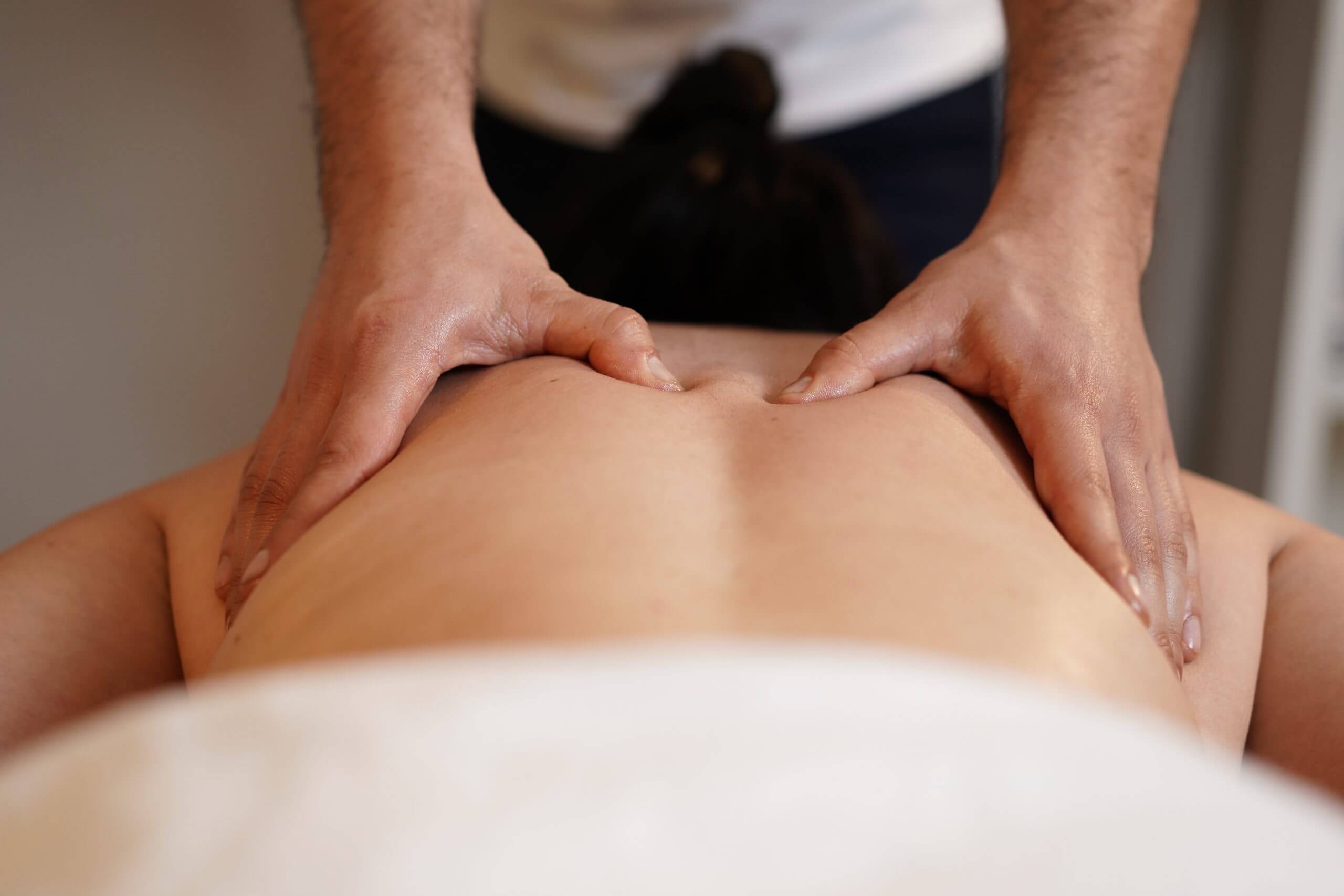
Deep tissue is the treatment for pain that has outstayed its welcome. Not the stiffness of a bad night, but the knot between your shoulder blades that has been there since March, or the lower back that tightens every time you sit down.
The work is slow and specific. I use sustained pressure, forearm and elbow as much as hands, on the deeper muscle layers and on trigger points, those hyper-irritable spots that refer pain somewhere else entirely.
What it does
- Releases chronic knots and trigger points
- Relieves neck, trapezius and lower back pain
- Restores range of motion lost to old stiffness
- Speeds recovery between hard training blocks
- Breaks the cycle of pain that keeps returning to the same spot
Who it is for
- Chronic neck, shoulder or lower back pain
- Athletes in a heavy training block
- Desk posture pain that keeps coming back
- Old stiffness from an injury that healed badly
- Anyone who finds a relaxing massage not enough
Why pressure alone is not the point
Deep tissue is often sold as just more force. It is not. Pressing harder on a guarded muscle makes it guard more. What actually releases a chronic knot is pressure held long enough, in the right spot, for the tissue to stop defending itself.
That means a deep tissue session covers less ground than a Swedish one. I would rather spend twenty minutes on one trapezius that is genuinely the problem than pass over the whole body and change nothing.
Where the work usually goes
The neck and upper trapezius, for people who spend their day on a screen or a phone. The lower back and glutes, for drivers, for anyone lifting badly, and for lower back pain that comes back every few months.
The legs and calves for runners and cyclists. The forearms for musicians, hairdressers and anyone typing eight hours a day, which is a region almost nobody thinks to ask for and which is often the real source of wrist pain.
Cupping and dry needling, when they help
Cupping can be added to a deep tissue session at no extra cost. The suction lifts the tissue instead of compressing it, which works well on a broad, flat area like the lower back where pressure alone struggles to get underneath.
Dry needling comes out when a trigger point will not let go manually. It is quick, it is not acupuncture, and I only use it when the manual work has already told me exactly where the problem sits.
About the soreness
Feeling sore for twenty-four to forty-eight hours afterwards is normal and expected. It feels like the day after a good training session, not like an injury. Drink more water than usual and move gently rather than resting completely.
What is not normal is sharp pain, bruising or anything that lasts beyond three days. If that happens, tell me, because it means we went too hard and the next session gets recalibrated.
How a session goes
- 01We locate the problem together: where it hurts, when it started, what makes it worse.
- 02A few minutes of broader work to warm the area so the deeper work is tolerable.
- 03Sustained, specific pressure on the layers and trigger points that matter, with cupping or needling if useful.
- 04Two or three things to do at home, because a session alone will not hold if the cause stays in place.
Questions about this treatment
- Does deep tissue massage hurt?
- It should feel like a strong, satisfying ache, the kind you lean into. It should never be a pain you fight. Tell me the moment it crosses that line and I back off.
- What is the difference with soft tissue manipulation?
- Deep tissue presses into the muscle. Soft tissue manipulation stretches and mobilises it. Deep tissue suits a local, stubborn knot. Soft tissue suits a whole muscle group that has lost its range.
- How many sessions will I need?
- Pain present for a few weeks usually eases within two or three sessions. Pain present for years takes longer and needs work between sessions. I will tell you honestly after the first one.
- Can I train the same day?
- Light movement is fine and even helps. Avoid a heavy session or a competition in the twenty-four hours that follow.